
Weaker Green Incentives
HB 1775 Would Allow Utilities To Invest In Fossil Fuel Generation

Also on today’s menu at the News Café:
Clegg Wins Argument Against Unreasonable Search
Gov. Ayotte Vetoes Bipartisan Paint Disposal Bill

The House Finance Committee has recommended an amended version of House Bill 1775 that would reverse New Hampshire’s restructuring of electric utilities that, starting in 1996, forced utility companies to divest themselves of most power generation facilities. The bill would allow the companies to own natural gas generation plants producing as much as 5 megawatts of power, similar to what they are allowed for renewable energy such as solar arrays. While the bill also allows utility ownership nuclear power generation facilities, the 5 megawatt limit rules out current nuclear plant options. Scientists are working on small modular reactors and microreactors that would produce lesser amounts of energy, but even they would generate at least 20 megawatts.
HB 1775 also limits the amount of fossil fuel generation (and hypothetical nuclear) to 10 percent of its peak power distribution.
Representative JD Bernardy (R-Hampton), who sponsored the bill, said he hoped it would encourage the building of more gas and nuclear power plants in New Hampshire to boost the state’s energy supply. Representative Douglas Thomas (R-Londonderry), vice-chair of the House Committee on Science, Technology, and Energy, said increased electric generation could support the development of high-energy-use projects, such as data centers.
Discussion: The state’s restructuring of the electricity industry was intended to increase competition and diversification of the power market to promote renewable energy. By allowing utilities to own fossil-fuel (and nuclear?) generation facilities, those incentives are weakened. There also is another proposed bill that would repeal of a section of New Hampshire law to weaken generating plants’ efficiency and emissions standards.
Clegg Wins Case Against Unreasonable Search

The New Hampshire Supreme Court has ruled that, because Concord police detectives failed to obtain a warrant before asking Verizon for cell phone location and text data for Logan Clegg, they violated his constitutional rights against unreasonable searches. They used the cell phone’s location data to track and arrest Clegg before his scheduled flight to Germany. They found a gun, a fake Romanian passport, and $7,000 in cash inside his backpack.
Clegg pleaded not guilty but he was convicted of killing Stephen and Wendy Reid in April 2022 on a walking trail near their Concord home. He received a 100-year prison sentence for the crime, but the improper arrest procedure could weaken the state’s case if Clegg is able to obtain a new trial. A lower court now will consider whether the evidence obtained without a warrant may have reasonably been obtained through another avenue. Based on those findings, the Supreme Court will determine whether to order a retrial.
Merrimack County Superior Court Judge John Kissinger, who presided over Clegg’s 2023 trial, had ruled that, given the seemingly random nature of the violence and Clegg’s purchase of a plane ticket, the detectives were justified in contacting Verizon before obtaining a warrant. The Supreme Court disagreed, ruling that the detectives could have applied for the warrant while simultaneously asking Verizon for the location data. “We acknowledge that there was considerable evidence before the trial court that the defendant posed a substantial threat of danger to the public,” the justices wrote, but “five months had elapsed between the murders and the initial exigency request and that there was no evidence” that Clegg had committed additional crimes.
Discussion: The constitutional prohibition on unreasonable search and seizure must be observed. The Supreme Court found, “It is unreasonable that any individual’s freedom from governmental intrusion might be curtailed by virtue of how long it may or may not take a third party to respond to a warrant” and that authorities still could have intercepted Clegg at the airport prior to his departure.
Gov. Ayotte Vetoes Bipartisan Paint Disposal Bill
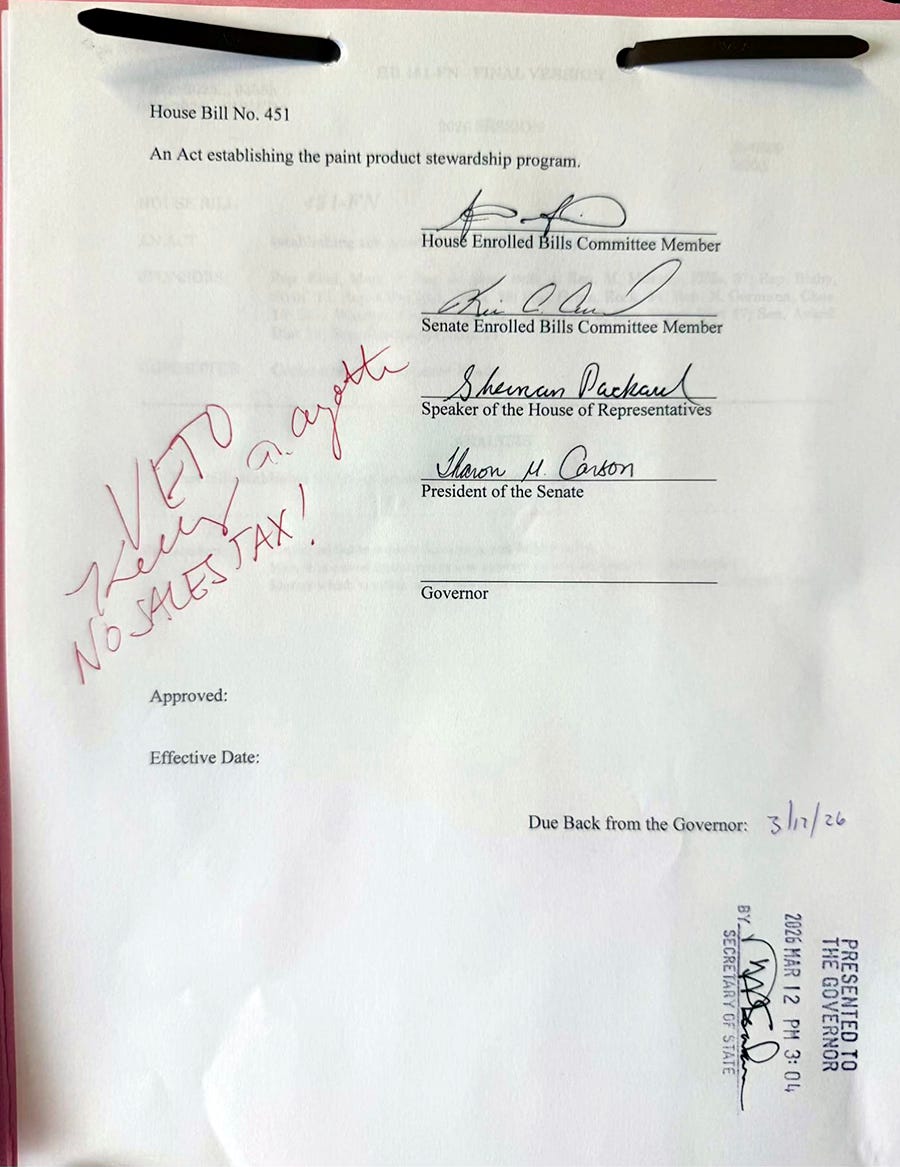
House Bill 451, requiring paint manufacturers to submit a stewardship plan outlining procedures for the collection, storage, transportation, reuse, recycling, energy recovery, and disposal of paint sold in New Hampshire, had the support of a broad range of interests, including Casella Waste Systems, the Business & Industry Association, and the New Hampshire Municipal Association — but not Governor Kelly Ayotte, who vetoed the bill, posting her objection on social media with the handwritten “NO SALES TAX!”
The lead author of the bill, Representative Karen Ebel (D-New London) responded, “It’s not a sales tax. There is no money that’s going to the state. If you look at the fiscal note, there is nothing that involves the state at all.” Instead, the bill requires the paint manufacturer to pay an assessment amount set forth in its approved plan to cover the costs of the “‘representative organization’ … established by a manufacturer to implement a post-consumer paint stewardship program”.
NHPR reports, “The revenue would have flowed to PaintCare, a non-profit that would collect unwanted paint. PaintCare was launched in Oregon in 2009, but now operates in 10 other states, including Maine, Vermont and Rhode Island.”
Discussion: There is nothing in the bill identifying PaintCare as the entity providing paint stewardship; rather, it speaks only of a “non-profit”. PaintCare may be the only option at the moment, but other organizations are allowed to offer the services under the legislation. It certainly is not a “sales tax” as Ayotte would have people believe. It would be a cost of doing business — taking responsibility for the products it sells.