
Real Concerns
Justice Department Takes A Stand Against 'Divisive Concepts' Bill

Also on today’s menu at the News Café:
Health Concerns Remain About Nuclear Power Plants
NH House Abdicates Responsibility To Constituents

The NH Department of Justice has taken a stance in opposition to House Bill 1792, or the CHARLIE (Countering Hate and Revolutionary Leftist Indoctrination in Education) Act, which aims to prevent public school teachers from “indoctrination” of students in “divisive concepts” such as Marxism and critical race theory. Named in honor of the murdered leader of Turning Point USA, Charlie Kirk, the bill had passed the House of Representatives last month and was headed to the Senate.
Assistant Attorney-General Sean Locke, head of the Justice Department’s civil rights unit, told the Senate Election Committee that the bill “presents constitutional concerns and risks conflicts with other laws…. The litigation risk and conflict of laws lead us to oppose this legislation as written.”
Locke pointed to the bill’s prohibition on the “affirmation” of LGBTQ+ ideologies as an example of the problem. “The concern here is going to be, what is affirmation?” he said. “Is it requiring a student to treat another person, an LGBTQ+ person, with dignity and respect and affirmation of identity, or does it require more?”
Discussion: The Senate Education Committee will resume its hearing today. Representative Mike Belcher (R-Wakefield) said he crafted the bill’s language to address concerns about vagueness in previous attempts to pass divisive concepts bills. “I have no doubt that this will be challenged,” he said. “Anything controversial is going to get challenged in the state of affairs in our country right now.” He is right, but when the state’s Justice Department, which rarely gets involved in legislation, expresses concerns, senators should take notice.
Health Concerns Remain About Nuclear Power Plants

As nuclear power gains support as an alternative to fossil fuels, those living near the Seabrook nuclear power plant advise caution. “Everyone who dies on this street dies of cancer,” said Marie Souther, a lifelong resident of Seabrook’s River Street. “I’ve known a lot of people that have had cancer on this road. I don’t know if it’s got anything to do with the plant — it probably doesn’t — but they do release a certain amount of steam. … They claim it’s a safe level of radiation. Well, you talk to most scientists, and there ain’t no such thing as a safe level of radiation.”
Sarah Abramson, executive director of the nonprofit radiation monitoring organization C-10, noted that the journal Nature Communications ran an article about a study comparing nationwide cancer death data to the proximity of patients’ homes to nuclear power plants. The analysis concluded that the association was strongest in men aged 65-74 and women aged 55-64, but was also evident in other age groups. Yazan Alwadi, a researcher at the Harvard T.H. Chan School of Public Health which conducted the study, said that, even taking into account other potential factors, such as smoking and socioeconomic status, the connection was there.
The American Nuclear Society, a nonprofit organization of nuclear engineers, industry workers, and scientists, criticized the study, arguing, “This flawed ecological study does not advance our understanding of radiological risk. The authors themselves state that their findings ‘cannot establish causality’ and that their study ‘does not include dosimetry [measurement, calculation, and assessment of the ionizing radiation dose absorbed by the human body],’ admissions that undermine the study’s central premise and that ANS urges journalists and policymakers to weigh carefully.”
Discussion: Before the nation moves toward more nuclear power, there should be comprehensive studies to determine the risk. Like most federal agencies under the Trump administration, the Nuclear Regulatory Commission cannot be trusted to make sure nuclear reactors are safe. Abramson noted, “We’re seeing major changes in the federal landscape that’s really reducing radiation protection, changing emergency planning, changing even the amount of staff that might be at these new types of reactors.… I’ve seen a decline in the amount of transparency that I’m getting from nuclear regulatory commission staff.”
NH House Abdicates Responsibility To Constituents
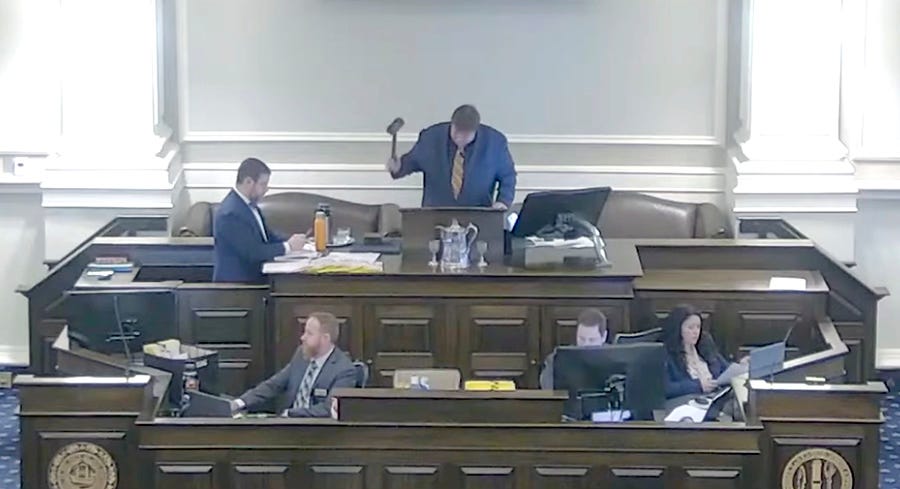
The NH House of Representatives had a midnight deadline on March 12 to decide the fate of 344 bills that had not been heard. The body first took up bills that committees had recommended for passage, leaving those recommended for defeat or further study to be taken up afterward. It was a reasonable approach, but Democrats criticized it because many of their bills would be pushed back against the deadline.
House leadership then took a step that would provide legitimate criticism: Instead of continuing the session until midnight to take up as many bills as possible, they adjourned the meeting in the afternoon, leaving 74 bills to automatically die without a floor debate.
Among the “deceased” bills was House Bill 1794, which would have required the NH Department of Health and Human Services to track how the state’s changes in Medicaid rules affect enrollees; House Bill 1165, which would remove “X” or “other” as an option for gender designation on individuals’ state identification; House Bill 1235, that would legalize possession of small amounts of cannabis for people over 21; House Bill 1334, that would have prevented the Children’s Scholarship Fund from approving expenses in Education Freedom Accounts; House Bill 1513, that would have created stricter reporting requirements over EF spending; House Bill 1804, consolidating school administrative units from 107 to 12 and making superintendents elected officials; and House Bill 1708, that would increase business taxes in order to reduce the statewide education property tax.
Discussion: While many of those bills deserved defeat, there is no excuse for preventing each legislative bill from getting a public hearing and vote. Knowing the volume of bills being proposed, the House should have scheduled more days to deal with them to avoid the last-minute crush. Adjourning early on the last day was an abdication of responsibility.