
Cost Uncertainty
School Administrators Oppose Open Enrollment Bill

Also on today’s menu at the News Café:
State, Voters Challenge Demand For Confidential Records
Police Arrest Protesters Refusing To Leave ICE Center
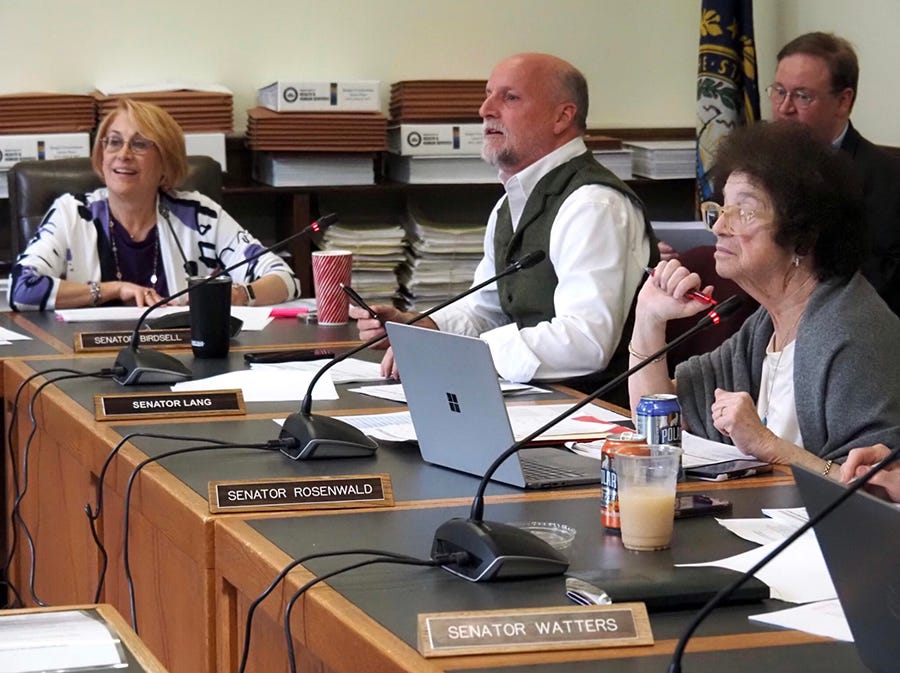
The New Hampshire School Administrators Association (NHSAA) has registered opposition to House Bill 751, as amended by the state senate, which would force school districts to adopt “open enrollment” while removing a provision of current law that allows school districts to restrict the number of students who leave for other school systems. Families may send their students elsewhere, but at their own expense, whereas the current (voluntary) open enrollment law would force taxpayers to pick up 80 percent of the home district’s per-student cost. HB 751 would increase that cost to the full amount the sending district is spending per pupil, with parents covering any excess cost per pupil to attend the receiving district.
The NHSAA said it is “fully prepared to partner with elected officials to broaden student choice” but that HB 751 overrides local decision-making. “Without careful consideration of ‘fixed costs’ and changing enrollment dynamics, such policies could place an undue financial burden on local taxpayers,” the association wrote.
Senator Tim Lang (R-Sanbornton) who wrote the final version of the bill, said it keeps public school dollars in public schools (as opposed to the Education Freedom Accounts that send public funds to private schools) while “still providing educational choice to parents”.
Discussion: The main problem with open enrollment is the difficulty it creates in controlling a school budget. An influx of students from another district could require additional educational resources, while an outflow of students could mean that an approved budget is higher than it needs to be. The only mechanism to relieve that concern is the bill’s provisions allowing school boards to determine whether they have the necessary space to accommodate additional students.
State, Voters Challenge Demand For Confidential Records
New Hampshire has filed a legal challenge to the Trump administration’s demand for the sharing of confidential voter information with the federal government. Lawyers representing a bipartisan group of voters also have submitted a legal brief objecting to the federal government’s demand for sensitive voter data.
Last July, Secretary of State David Scanlan refused to comply with the order, citing a state law that requires the statewide voter database to remain confidential. The Civil Rights Division of the US Department of Justice then filed a lawsuit against the state, asking the courts to compel the release of the database.
Attorneys for the state said the federal government’s lawsuit should be dismissed, as it “is neither supported by any viable legal theory nor by well pleaded facts.” The citizens’ lawsuit states, “Notwithstanding the President’s repeated call to ‘nationalize’ our purposefully decentralized election system, the Court should join other courts in dismissing this unprecedented federal overreach, which lacks any valid legal basis in federal law.”
Discussion: Judges in California, Michigan, and Oregon have dismissed similar lawsuits by the federal government that demanded voter files. Trump wants the federal government to play a central role in administering elections, despite constitutional provisions that place the states in charge of elections. Last month, the federal government raided the election offices in Fulton County, Georgia, seizing ballots from the 2020 election under a search warrant that failed to state probable cause and was issued after the statute of limitations has expired — with ballots already reviewed three times without a finding of fraud.
Police Arrest Protesters Refusing To Leave ICE Center
Vermont State Police arrested 11 people and cited two others on trespassing charges after they refused to leave a Williston office building that houses Immigration and Customs Enforcement’s National Criminal Analysis and Targeting Center. The protesters, ranging in age from 21 to 85, are scheduled to be arraigned on criminal trespassing charges in Chittenden County criminal court on March 2.
Organizers say that roughly 25 protesters gathered there to demand that the building’s landlord cancel ICE’s lease, singing and citing the number of people killed by ICE. The property manager called police, but while the Williston police stopped by, they took no action. Vermont State Police arrived to tell protesters to leave the building; some left, while 13 remained inside. The state police say they only started making arrests after people refused to follow the dispersal order.
Julie Macuga, a community organizer, said, “We just wanted to show what people are able to do. It often feels like we’re a little bit powerless, but I think we’re slowly making progress on this, and we’re going to keep going until ICE is out of Williston.”
Discussion: Some local government officials have responded to “hostile” federal actions by using existing state and local laws for “Soft Secession” — something Christopher Armitage of The Existentialist Republic describes as not “declaring independence or flying new flags. It means states, cities, and municipalities quietly building the capacity to govern without federal cooperation, so that when the federal government turns hostile, they already have the infrastructure to say no.”
The key points he makes are:
Here is what we can demand, and who already proved it works:
- Direct local police to investigate federal agents who break city or state law, document their findings with body cameras, and refer evidence to prosecutors. Chicago, Boston, and Seattle have done this.
- Impose fees and financial penalties on facilities that deploy chemical agents against civilians. Portland announced this after federal agents tear-gassed a crowd that included children.
- Enforce existing zoning codes against federal detention facilities. Portland cited an ICE landlord for at least 25 violations of a land use agreement and put $2.4 million in annual rent at risk.
- Ban federal agents from operating on city property without a judicial warrant. New York, Boston, Seattle, Minneapolis, and five additional cities around Boston have signed these orders.
- Restrict city agencies from sharing resident data with federal immigration authorities. New York and Seattle have done this.
- Coordinate executive orders with neighboring cities to create regional walls, not just municipal ones. Boston organized six cities to act together.
- Create a city-owned public bank to hold municipal deposits and finance housing and infrastructure without Wall Street. New York’s mayor entered office with legislation to do exactly this.