

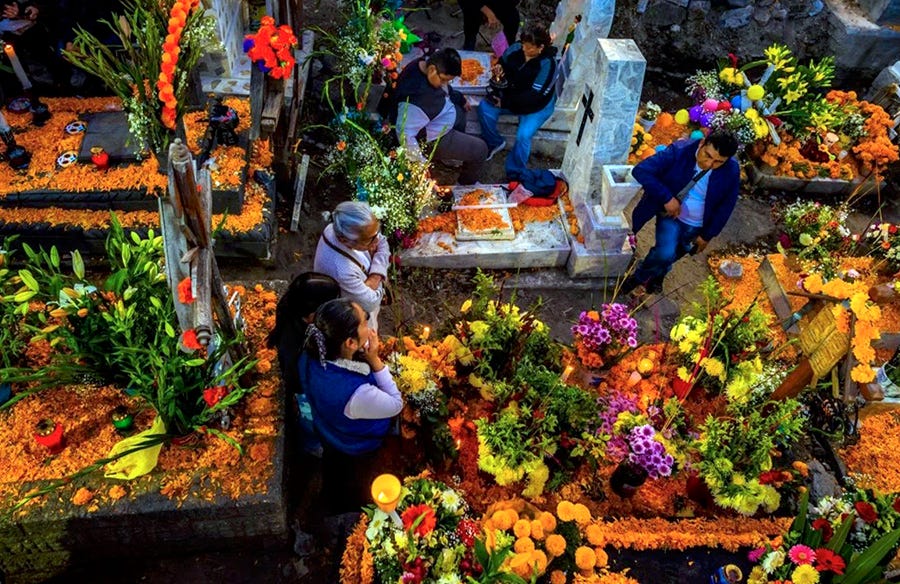
Historically, the phrase “beyond the veil” has referred to a mysterious, unseen realm, “most commonly the afterlife or a state of existence beyond our ordinary understanding”, according to theidioms.com. Marking a separation between physical life and metaphysical existence, the “veil” makes it inaccessible or mysterious to the living.
As Diana Butler Bass reminds us, we are ending a Christian triadic festival that began with Halloween on October 31, and continued with All Saints’ Day on November 1, and today, the Day of All Souls (aka, the Day of the Dead). It has its roots in the ancient autumn festival, Samhain, which, as Christianity expanded into pagan Europe, became embedded in the new religion. Samhain marked the harvest and the wintery sleep of the earth, just as the ancient spring festival, Ostara, celebrated planting and rebirth, and became Easter, with Holy Thursday, Good Friday, and the first Mass of Easter (Easter Vigil or Easter Sunday).
Both of the triadic festivals, falling on or near seasonal equinoxes of Earth’s cycles of fertility, are held in the liminal times when winter gives way to summer or summer passes onto winter. They mark the transitory balance of dark and light, the two rare moments when moon and sun are equal. One leads toward lengthened days while the other leans into a long night. These are the betwixt and between times when earth is neither fully one thing nor the other, when, it has always been believed, the veil between time and space thins.
The state of artificial intelligence similarly exists in a liminal period between past and future, and our understanding is veiled between hopes for what may be accomplished and dread of what it may mean for mankind.
Already, there is regret about what AI has accomplished: Harvard Professor Jill Lepore, author of The Rise and Fall of the Artificial State, reports in an interview at the Chronicle of Higher Education, “I was in South Carolina a couple weeks ago. I went to the College of Charleston. A couple hundred students showed up for a conversation. I had pretty much the same experience that I’ve had with any college audience recently. They had just three things to say. One, social media completely destroyed their childhoods. Two, AI is destroying their college education and their likely prospects for employment. And three, what the hell are we all doing?”
John Warner, in his The Biblioracle Recommends, writes, “Tuesday afternoon, when I had a bit of free time, I sat on a bench in the Arcata town plaza to enjoy the incredible sunshine. Arcata takes its status as a place welcome to weirdos seriously and the weirdos were present. This is a feature, not a bug, just as the infinite varieties of human beings are far more fascinating than the optimized outputs of generative AI.
“While I turned my face to the sky, a man across the plaza from me listened to Elton John’s ‘The Bitch Is Back’ on his phone, singing along to the lyrics and punching the air during the chorus. I started tapping my foot to the beat and (softly) singing the chorus myself.
“I thought of the infinite number of things that had to happen to put me and this dude on that plaza at the same time and figured it was simultaneously impossible and inevitable, and that’s why we’re going to win.”
He was referring to the battle against artificial intelligence.
Yet Warner also praised Josh Brake for his post describing when AI is useful. Brake shares the concerns about the ways it should or should not be used in writing, and referred to the resignation of Dartmouth College Provost Santiago Schnell over his undisclosed use of AI in his work.
While appropriately disclosing AI use is important, this is only part of the story. The more significant questions are about the use itself, not simply transparency about it. If we want to figure out how AI should interact with our writing, we need to spend time talking not only about how we are or are not using AI in our writing process, but why.
Brake concedes that AI is very useful in writing computer code for software: “[W]e are seeing throughout the industry, leaning more heavily on AI to do the grunt work of generating the code is often warranted, provided that you can retain the proper level of understanding over the software that is being generated so that you can verify that it is operating as you expect.”
He goes on to say, “When you are writing to figure out what you think, leaning on AI is not a great idea. … However, what if you have already workshopped your idea without AI and then want to use AI to help you better communicate it? AI can help you to workshop and clarify your ideas….”
AI can be used in this mode to help identify aspects of your writing that may be unclear; from clunky transitions to incorrect word choices, to awkward metaphors. I describe this way of using AI in your writing as “spellcheck plus.”
AI should not be used for what Brake refers to as “writing to care”:
If you are writing to care, then the entire point of the writing process is for your writing to embody your desire to connect with and care for your reader. There are any number of places where we do this kind of writing: toasts, personal emails, eulogies, thank you notes, etc. In these situations, using AI even just to clean up the grammar, style, or spelling is likely going to bleach out the very thing — the raw human expression with all its imperfection — that makes this kind of writing meaningful.
Like Brake, I can say, “none of the words that I write here on my blog are generated by AI. No one is forcing me to write here and the reason that I write is to try and figure out what I think. Using AI to generate these posts would defeat the whole point.”
Yet I have found AI to be useful in covering meetings or doing interviews: I can record the conversations and have them converted into a transcript I can refer to when writing the story. The transcripts are imperfect and sometimes humorous in how they misinterpret the words spoken, but they lead me to the part of the audio recording I need to get the quote right or reinforce what I thought I heard. AI provides a useful summary of the points made and the tasks to be accomplished.
It is important to acknowledge when one uses artificial intelligence, but as Brake says, conversations should not start “with some sort of purity test around whether or not AI has touched your words in any way, but with a conversation about the purpose of writing and how that might help us to choose our use of AI wisely”.
Of course, there are other concerns about what AI is bringing about: a demand for resource-hungry data centers, the possibility of autonomous agents breaking free and wreaking havoc on confidential information, economic systems, and especially, perhaps, our ability to know what is true and what is “hallucination”. As for the future of mankind in an AI-dominated world? That is simply beyond the veil.
Café Chatter
On Another Blow to Veterans: For a political party that insists that they are, “for the veterans “. The GOP has already fired a great percentage of health care workers and doctors from VA hospitals. They have decreased the level of care. They have decided to reexamine the level of partial disability for combat veterans. That’s just a few of the things that this regime, who loves our active military and veterans show it. As for our friend Robbie, who was taken care of in the Veterans hospitals. He had excellent care. He was well taken care of during hospice. Because, he was there before the draconian cuts. I feel, when people post things like, our taxes should not go to illegal immigrates, and legal, instead of our veterans. That’s all bull. It’s trying to disguise that the GOP simply doesn’t care, and using an excuse that doesn’t need to exist. . And, as a nation, if we truly cared about our veterans. Why do we have so many non profit organizations to help pay for medical equipment. Housing. Why during Operation Storm soldiers were telling their family members to send items like, soap! Shampoo! Etc. I just think about the movie, Born on the 4 th of July. My brother was in Vietnam. He came back physically ok. However, his hair was almost completely gray at 22. Then, at least, veterans benefits for schooling and assistance for buying homes were still in tact. And, he was able to take advantage of them. Yeah. I guess you can tell my passion, and anger. Did you know that it was Al Franken who got the bill through Congress for service dogs to be paid for by our taxes. And, then, the Republican who were in power, didn’t appropriate the funding. Until the Democrats took back the White House and Congress. The young veteran who went to Franken for help. He had PTSD. He did finally receive his service dog. Unfortunately, the care that he needed was too late and he committed suicide after leaving his service dog with a friend. Living outside of DC for so many years. It was mainly veterans and the mentally ill sleeping on benches in DC. One and the same in many cases. It just makes me so very angry. Never mind what a disgrace we are seeing today. Sorry. It just infuriates me.
— Candace Skurnik