
A Reasonable Compromise
Civil Rights Act Must Recognize Free-Speech Guarantees

Also on today’s menu at the News Café:
Much Of The ‘Ought To Pass’ Legislation Is Flawed
Report Shows All-Around Failures In Relaying Information
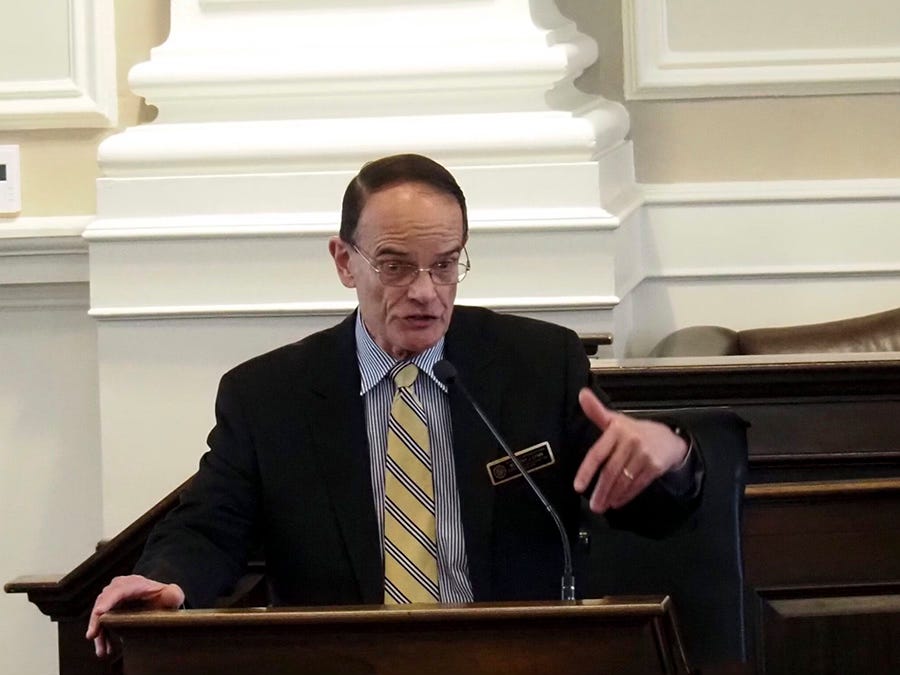
The NH House of Representatives has adopted an amendment to a bill seeking to address the Justice Department’s overreach when, in July 2022, it used the state’s Civil Rights Act to seek fines against the white supremacist group NSC-131 for hanging a banner from a highway overpass with the message “KEEP NEW ENGLAND WHITE.” The NH Supreme Court struck down the charge in January 2025, in part on free-speech grounds: “The overbreadth of the State’s construction of the Act creates an unacceptable risk of a chill on speech protected by Part I, Article 22 of our State Constitution.”
The amended bill requires a person to be motivated “in part or in whole” by hostility in order to be charged under the act, and it applies to actions or threats of using unlawful force, committing an act of violence, and damaging property or trespassing. It clarifies what counts as threatening: It must be something that a reasonable person, with reasonable knowledge, would view as a realistic threat that the person is capable of carrying it out. The new language also stipulates that the Civil Rights Act cannot prohibit speech or conduct protected by state and federal constitutions.
The House passed the amendment to Senate Bill 464, 329-9, and it now heads back to the Senate for final approval.
Discussion: The compromise does what it should do: It protects free-speech rights while better defining the grounds for legitimate civil rights litigation.
Much Of The ‘Ought To Pass’ Legislation Is Flawed
Legislation that committees have recommended as “ought to pass” includes House Bill 1115 which adds a definition of “citizen of New Hampshire” as “a citizen of the United States of America who is domiciled in New Hampshire”. That is a reasonable bill.
Also with “ought to pass” recommendations, however, are three bills (House bills 1217, 1299, and 1447), allowing the classification of individuals based on biological sex in certain “limited circumstances”.
HB 1217 “permits the public and private classification of individuals based on biological sex in multi-user lavatory facilities and in athletic competitions where biological males have a competitive advantage. The bill also establishes that these forms of separation based on biological sex do not qualify as discrimination.”
HB 1299 has similar language for “multi-user facilities, athletic and sporting competitions, and correctional and treatment facilities” and HB 1447 “requires the state of New Hampshire and all political subdivisions of the state to adopt policies that classify the use of restrooms, locker rooms, changing areas, and sleeping quarters by sex” and “authorizes private entities to adopt the same policies relative to biological sex, and establishes that all public or private policies adopted pursuant to the section shall not constitute discrimination”. The latter bill goes on to state, “The presence of members of the opposite sex in such spaces can compromise privacy and create risks of harassment, assault, embarrassment and trauma.”
Discussion: The motivation behind the bills is not necessarily bad, but with the exception of the citizenship bill, they promote discriminatory assumptions that do not match reality. Any concerns about privacy and embarrassment in restrooms and locker rooms can be addressed by providing private stalls and changing areas. Risk of harassment and assault is not confined to members of the opposite sex and generally occurs among members of the same sex. Those who choose to change gender are less likely to harass, having often been the subject of harassment themselves. “Bathroom bills” rely on assumptions that are disproven by camping experiences and travel where separate facilities often are unavailable. Where discrimination is real is in the bills that create it.
Report Shows All-Around Failures In Relaying Information
Governor Kelly Ayotte forced Sarah Stewart, who served as commissioner of the Department of Natural and Cultural Resources, to resign after the Washington Post leaked a draft plan by federal immigration officials to convert a vacant Merrimack warehouse into an immigration detention center and revealed that the state was aware of those plans. Ayotte then asked the Department of Justice to investigate the interactions between Natural and Cultural Resources, Immigration and Customs Enforcement, and the New Hampshire chapter of the American Civil Liberties Union.
The upshot of the investigation was a finding that Benjamin Wilson, director of the NH Division of Historical Resources, had failed to properly notify state officials about the plans. Attorney-General John Formella’s report found no evidence of “nefarious intent” but criticized Wilson’s failure to alert his superiors about the plan and made several recommendations to strengthen communication and increase transparency within the division.
The investigation showed that an ICE consultant had emailed Program Specialist Liz Schneible on January 12, stating that ICE “is proposing to purchase, occupy and rehabilitate a 43-acre warehouse property” in Merrimack “in support of ICE operations” and attaching a letter requesting a “106 review”. Schneible forwarded the message to Deputy State Historic Preservation Officer Nadine Miller and asked Preservation Planning and Development Coordinator Brandee Loughlin whether she had seen the request. Loughlin said she had.
“Deputy Miller stated that she knew there were heightened public concerns relating to ICE, and that she considered elevating it to her supervisor, Director Wilson. She did not do so at that time. Deputy Miller, who has worked for DHR since 2007, was also unaware of any policies or directives regarding when staff should elevate a 106 review to her, or when she should elevate one to her supervisor, Director Wilson…. Several days later, Ms. Loughlin also spoke to Deputy Miller in person about her concerns with ICE’s 106 review request. … Ms. Loughlin recalled that Deputy Miller told her they treat all 106 reviews the same and to do her work as usual. Similarly to Ms. Schneible, Ms. Loughlin did not consider telling Director Wilson about ICE’s contact directly, because Director Wilson is generally not deeply involved in staff’s ‘day-to-day’ tasks, including the details of 106 reviews.”
Miller has stated that the first he recalled learning about ICE’s 106 review request was when the ACLU submitted its 91-A request later that January. The report stated that “No interviews or documentary evidence indicated that anyone within DHR, or within DNCR more broadly, had any contact with ICE or its consultant(s) aside from ICE’s initial inquiry to Ms. Schneible, Ms. Schneible’s response to submit through EMMIT+, and Deputy Miller’s final, automatic approval letter.” It was not until February 3, after responding to the ACLU’s 91-A request that Stewart received her first text informing her of the situation.
Discussion: The report concludes that “DNCR did not adequately foster a culture of elevating sensitive issues to leadership in a timely manner” and made several recommendations: “DNCR should centralize its 91-A response process. … DNCR should formalize reporting requirements and foster a culture of communication. … DNCR should strengthen its processes relating to the Governor’s biweekly report. … DNCR should retrain all staff on 91-A.” Essentially, it was a failure all around. The unaddressed and overarching issue is how the state should respond to federal requests to support immigration policies that, by the Department of Homeland Security’s own accounting, have included widespread use of physical abuse, chemical agents, and depriving captives of food, water, and medical care. As of April 4, 60,311 detainees were being held in ICE custody, with 70.8 percent of them having no criminal convictions, and many of those with convictions having only minor offenses, including traffic violations. Several ICE agents have been charged with sexually assaulting detainees. Yet the government has billions of dollars yet to spend in expanding the agency.