

Also on today’s menu at the News Café:
Vermont Turns to Canada For Clean Energy Needs
White Mountains’ Wild River Fire Challenges Firefighters
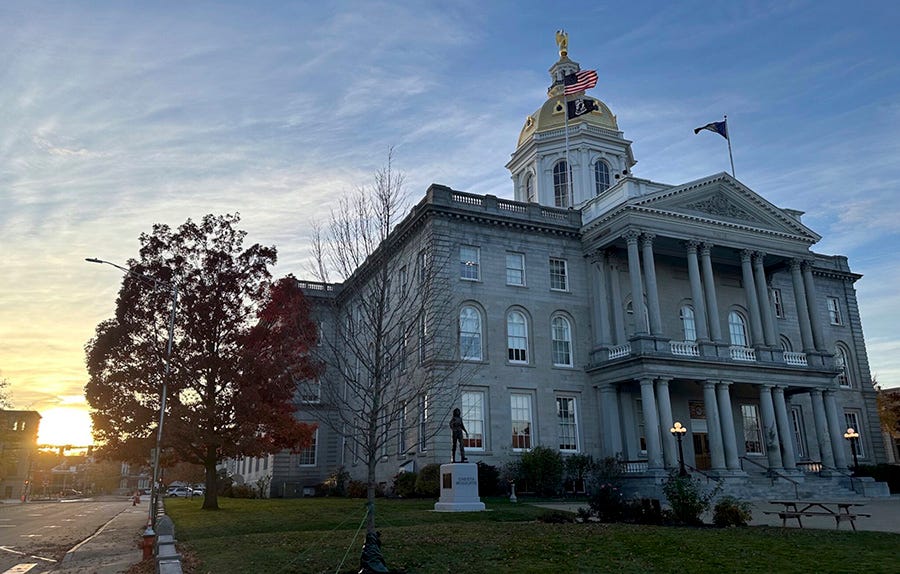
As voters head to the polls today, one of the questions on the ballot asks for a constitutional amendment to eliminate the position of register of probate, which appears in two sections of the New Hampshire Constitution, adopted in 1784. Since 1877, it has been a two-year elected position that, until 2011, functioned like a court clerk, assisting judges who oversee cases involving wills, estates, and trusts.
The New Hampshire Legislature approved a major consolidation of the courts in 2011, folding of the work of the probate court into a new circuit court model and reassigning the registers’ work to other court staff members without eliminating the constitutional position. Instead, the legislation lowered the register’s salary to $100 a year and left the position with one job: the archiving of records. Now that that job has been farmed out, the register of probate essentially has no responsibilities, but still the position is on the ballot and the official continues to draw that $100-per-year salary.
The only way to eliminate the position is to amend the New Hampshire Constitution — something Donna Sytek, a former speaker of the House, attempted to initiate in 2016. The effort failed.
Discussion: Sytek notes, “They don’t have any function. They don’t have an office. They don’t have a phone.” Yet Jane Bradstreet, one of the state’s longest-serving registers, said, “I can be helpful sometimes for folks.” Before the change in 2011, the register of probate served as a liaison “between residents and a complicated bureaucracy” and, even without a desk, publicly available phone number, or website, Bradstreet says people still contact her through word-of-mouth.
Vermont Turns to Canada For Clean Energy Needs
ISO New England, which is responsible for ensuring the reliability of the region’s power grid, is predicting that the demand for electricity will grow in the coming years as more people drive electric cars and install heat pumps at the same time the region is shutting down oil-burning power plants. Yet the Trump administration has blocked clean energy options, buying out contracts for offshore wind projects already under construction that could have met that need.
The situation has Vermont Governor Phil Scott turning to Canada, signing a three-year agreement with Nova Scotia to explore the possibility of importing electricity generated by Canadian offshore wind. “As a small state, we can’t generate affordable, clean, and reliable energy alone, which is why regional partnerships are critical to reaching our goals,” Scott said.
With federal opposition making it unclear if or when new offshore wind will get built in New England, Nova Scotia is soliciting bids to build some 15 gigawatts of offshore wind power, and Hydro Quebec also has expressed interest in developing offshore wind farms.
Discussion: Nova Scotia Premier Tim Houston said, “This agreement with Vermont is an important step as we build connections with energy partners … and position Nova Scotia to become a clean energy superpower.”
White Mountains’ Wild River Fire Challenges Firefighters
The federal government has assigned 40 personnel to respond to a wildfire in the White Mountains that has burned about 300 acres on steep terrain. The cause of the Wild River Fire is under investigation.
The fire was spotted on Sunday afternoon, about seven miles southeast of Gorham. The White Mountain National Forest Service reported, “The Wild River Fire is actively burning in timber, snags, and leaf litter. Gaining access to the fire is difficult due to steep and rugged terrain.”
Regional drought conditions in the mountains also make it difficult for firefighters, who are working to create a perimeter around the fire.
Discussion: The fire is considered to pose no risk to individuals at this point.